
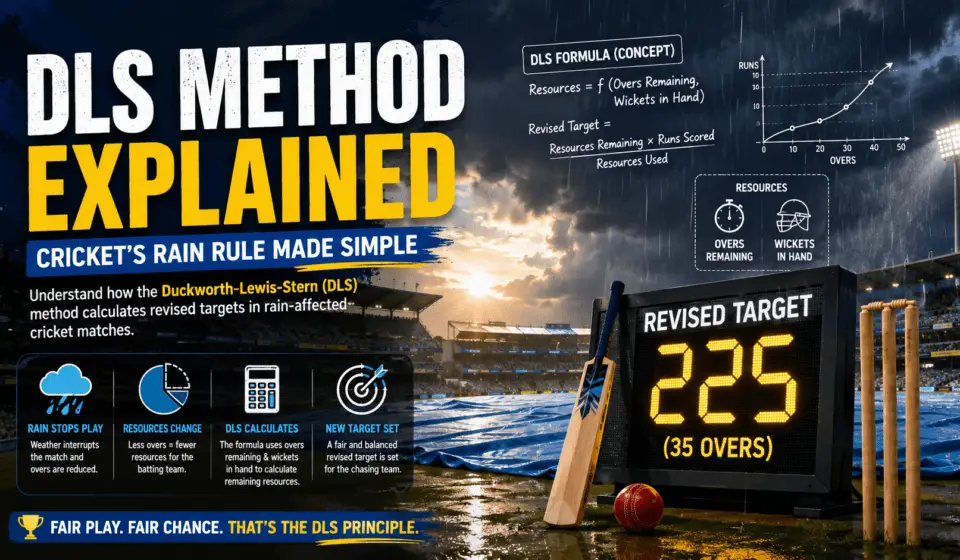

If you have ever watched a cricket match interrupted by rain, you have probably heard commentators say:”The target has been revised using the Duckworth-Lewis-Stern (DLS) Method.” Many cricket fans become confused at that moment. Questions like these often come to mind: What is the Duckworth-Lewis-Stern Method? And How is the new target calculated?
The good news is that the Duckworth-Lewis-Stern (DLS) Method is much easier to understand than it looks. In this guide, we will explain everything in simple language with real-life examples.
What is the Duckworth-Lewis (DLS) Method?
The Duckworth-Lewis-Stern (DLS) Method is a mathematical formula used to decide the target score in rain-affected limited-overs cricket matches, including:
- One Day Internationals (ODIs)
- T20 Internationals
- IPL matches
- Domestic limited-over tournaments
Whenever rain reduces the number of overs available, both teams no longer get equal opportunities. The DLS Method adjusts the target so that the match remains as fair as possible.
Why Was the Duckworth-Lewis (DLS) Method Introduced?
Imagine this situation. Team A scores 320 runs in 50 overs.Before Team B starts batting, heavy rain arrives. Now Team B gets only 25 overs.Should they still chase 321? Obviously not.But should the target simply become half, around 160? Not necessarily. Batting in the first 25 overs is very different from batting in the last 25 overs. Teams usually save wickets early and score much faster near the end.This is exactly why the DLS Method was created.
What Does Duckworth-Lewis-Stern Stand For?
DLS stands for:
- Duckworth – Frank Duckworth
- Lewis – Tony Lewis
- Stern – Steven Stern
Duckworth and Lewis originally developed the system.Later, Steven Stern improved it, and today it is officially known as the Duckworth-Lewis-Stern (DLS) Method.
How Does the Duckworth-Lewis-Stern Method Work?
The DLS Method is based on one simple idea.A batting team has two important resources: 1.Overs remaining and 2.Wickets in hand. The more overs and wickets available, the greater the team’s scoring potential.If rain reduces overs, the batting team’s resources decrease.The DLS Method calculates exactly how much of those resources have been lost and sets a revised target accordingly.
🏏 Duckworth-Lewis-Stern (DLS) Method Explained
Understand cricket’s rain rule in less than 5 minutes.
⚡ Two Resources in Cricket
⏳ Overs Remaining
More overs mean more chances to score runs.
🏏 Wickets Remaining
More wickets allow batters to play aggressive shots.
📊 Total Resources
DLS combines overs and wickets to calculate a fair revised target.
⚙️ How DLS Works
📌 Simple Example
Before Rain
- Team A = 280 Runs
- 50 Overs
- Target = 281
After Rain
- Team B gets only 35 Overs
- DLS calculates remaining resources
- New Target ≈ 225 Runs*
*Example only. Actual target depends on wickets lost and resource tables.
🤔 Why Does Target Sometimes Increase?
| Situation | Reason |
|---|---|
| Many wickets left | Batters can attack freely |
| Rain removes slow overs | Only high-scoring overs remain |
| Higher scoring opportunity | DLS may slightly increase the target |
🏏 Compare Two Teams
| Team | Score | Wickets Left | Better Position? |
|---|---|---|---|
| Team X | 150/1 | 9 | ✅ Yes |
| Team Y | 150/8 | 2 | ❌ No |
Both teams have the same score, but Team X has more resources left, which is why wickets are important in DLS.
✅ Where is DLS Used?
💡 Remember This Formula
DLS = Overs Remaining + Wickets Remaining = Batting Resources
If rain reduces the batting resources, the target is revised to keep the match as fair as possible.
Limitations of DLS Method:
Rain has always been one of cricket’s biggest challenges. Before the DLS Method, interrupted matches often ended in confusion and controversy. Today, the Duckworth-Lewis-Stern (DLS) Method provides a fair, scientific, and widely accepted way to adjust targets when weather interferes with play. While the calculations may seem complex, the basic idea is simple: a team’s scoring ability depends on both the overs remaining and the wickets in hand. ICC has introduced this method in all formats for fair play.